Battery Packs and Cell Contacting Systems
E-mobility is the future of transportation. Hybrid and electric vehicles require efficient state-of-the-art energy storage systems. A key technology here are high-performance cell contacting systems (CCS), which connect the individual lithium-ion battery cells mounted on the plastic carrier boards that are then assembled into a complete battery system.
As batteries for electric cars have to work up into the high-voltage range, they must be assembled from hundreds of individual lithium-ion batteries while still fulfilling stringent performance, durability and safety criteria. Hoenle adhesives ensure on one hand loss-free energy transmission, and on the hand they are flexible enough to compensate for the different thermal expansion rates of the materials used within the connecting elements.
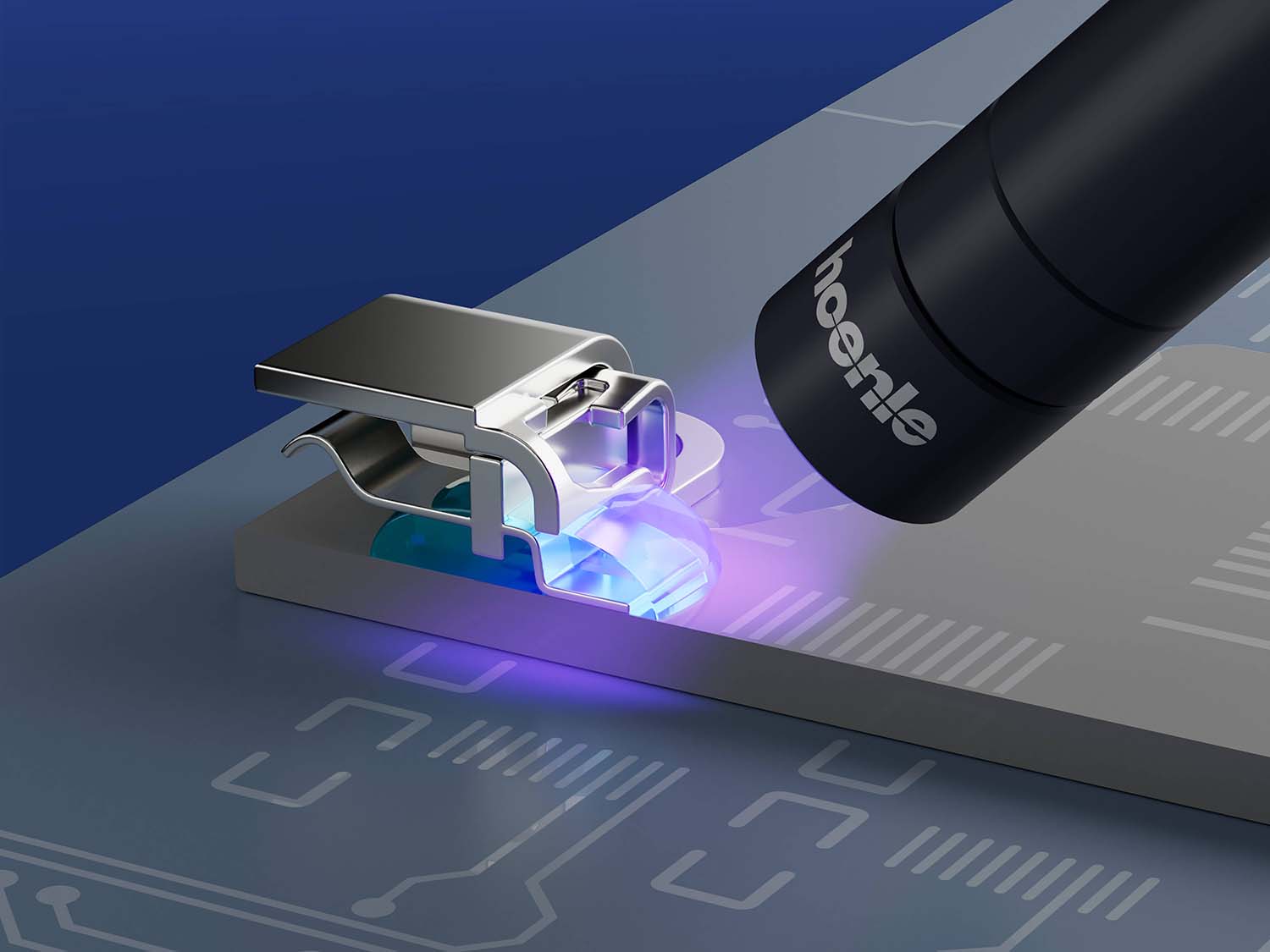
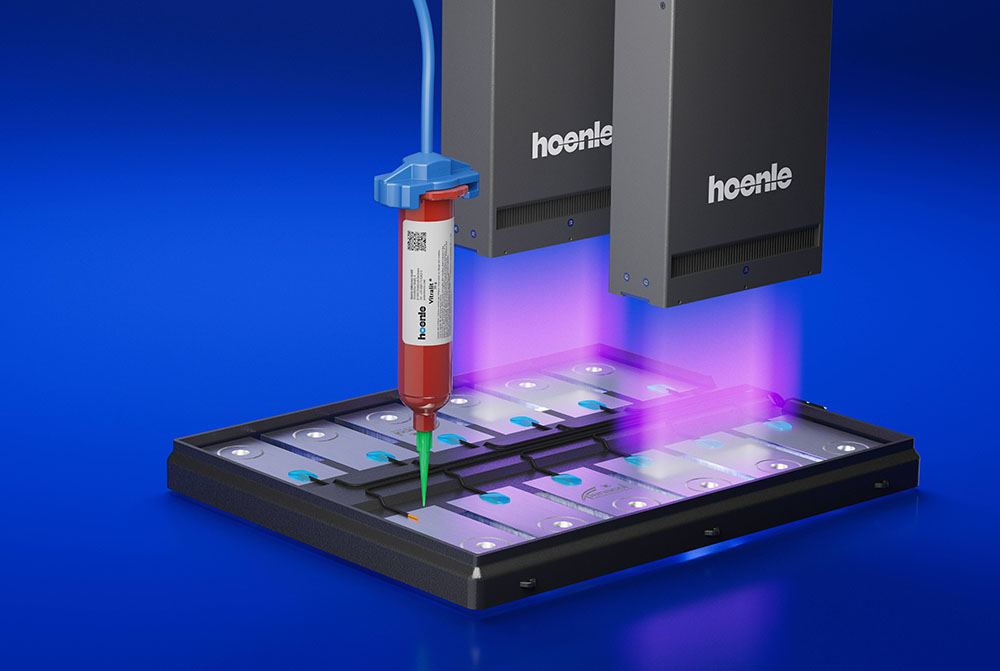
Welded copper tracks on battery packs and strands to flexible conductors create surfaces that are prone to corrosion. Hoenle has developed special UV adhesives with a low ion content that protect these welds from corrosion as well as providing mechanical support and compensating thermal expansion of the different materials. Specially developed UV glob tops and UV coatings offer flexible solutions for a wide range of CCS layouts and geometries.
For connecting and sealing welded joints on cell contacting systems and battery packs that contain shaded areas that the UV light cannot reach, Hoenle has developed special moisture-postcuring UV acrylates. Here, most of the adhesive is cured with UV light and its structure is polymerized, while residual monomers in the shaded area that remain uncured subsequently cross-link through air humidity. Full curing is therefore also achieved without additional crosslinking in the oven, thereby protecting the carrier board from unwanted heat exposure.
In many battery packs the control electronics are already integrated, so that the charge level and heat development in the battery pack can be continually monitored. For sensors Hoenle provides specially formulated adhesives.
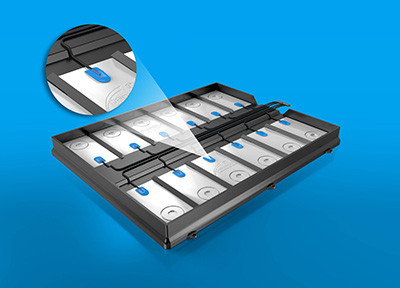
Welding points of cell contacting systems are covered with ionically pure adhesive to prevent corrosion
In the following table you will find a selection of adhesives suitable for the protection of welded joints and the encapsulation of battery packs and cell contacting systems. We would be pleased to advise you on our products and their application. Other products and customer-specific solutions are available on request. Technical data sheets can be downloaded by clicking on the adhesive name.
| Adhesive | Application Areas | Viscosity [mPas] | Base | Curing * | Special Properties |
|---|---|---|---|---|---|
|
3,000-5,000 | epoxy | UV secondary heat cure |
|
|
|
19,000-32,000 (Rheometer, 25°C, 10s^-1) | acrylate | UV VIS |
|
|
|
25,000-35,000 (Rheometer, 25°C, 10s^-1) | acrylate | UV VIS |
|
|
|
3,000-8,000 | acrylate | UV secondary heat cure |
|
|
| - | 8,000-17,000 (Rheometer, 25°C, 10s^-1) | acrylate | UV secondary heat cure |
|
|
|
8,000-11,000 (Rheometer, 25 °C, 5s-1) | acrylate | UV VIS secondary moisture cure |
|
|
| - | 200-400 (Rheometer, 25°C, 5s^-1) | acrylate | UV, VIS, moisture postcuring |
|
|
|
5,000-8,000 (Rheometer, 25°C, 10s^-1) | acrylate | UV VIS moisture cure |
|
|
| - | 10,000-15,000 (Brookfield LVT, 25 °C, Sp. 4/30 rpm) | acrylate | UV VIS |
|
|
| - | 80,000-120,000 (Rheometer, 25°C, 10s^-1) | acrylate | UV VIS |
|
|
| - | 2,500 – 4,000 (Rheometer, 25 °C, 5s-1) | acrylate | UV VIS secondary moisture cure |
|
*UV = 320 – 390 nm VIS = 405 nm
Contact And Support
Do you have any questions or need support for our bonding solutions? We are happy to help you.