
THE ENTIRE SPECTRUM FOR CURING
CURING AND DRYING WITH UV, LED-UV, IR/HA, INERT-UV, EXCIMER
We are the complete, solution-focused UV technology development partner, for solvent-free radiation curing and drying applications. We set technological trends, are well regarded for our engineering excellence and provide technology platforms that make processes more efficient and precise.
Our mission is to develop pioneering solutions in sustainable curing and drying technologies by combining innovation and a strong focus on customers and employees. We provide tailored, application-specific systems, open-technology consulting across the full spectrum – from UV, LED-UV and Nitrogen-Inertization to IR, Hot Air and Excimer – and deep technology expertise, enabling efficient and future-ready processes. With our consulting strength and close market orientation, we are a reliable partner throughout the entire value chain.
OUR MAIN APPLICATIONS

CASE STUDIES
Convince yourself of our UV systems and solutions for your success.
CURING AND DRYING WITH HOENLE AT A GLANCE
Hoenle Curing and Drying Solutions with UV, LED-UV, IR, Hot Air, Inert UV, Excimer for Printing, Converting and Coating Applications
DISCOVER OUR LATEST NEWS
EVENTS
glasstec
Düsseldorf, Germany
Co-Exhibitor IfG GmbH Ingenierbüro für Glastechnik
Hall 15, Booth D24
FAQs
What is UV curing and how does it work?
UV curing is a photochemical process that instantly hardens (polymerizes) inks, coatings, or adhesives using ultraviolet light instead of heat or solvent evaporation. When UV-reactive formulations are exposed to a specific wavelength of UV light, photoinitiators in the material trigger a rapid cross-linking reaction that transforms the liquid into a solid film within seconds.
Unlike thermal or solvent-based drying, UV curing requires no evaporation time and produces no VOC emissions, ensuring a fast and efficient process for industrial production lines in printing, converting, coating, and composite manufacturing.
What's the difference between conventional UV, LED-UV, and Excimer curing?
Conventional UV, LED-UV, and Excimer curing differ primarily in their light source, wavelength spectrum, and energy efficiency, making each suited to different production requirements.
- Conventional UV (mercury/gas-discharge lamps): Broad-spectrum UV output covering UVA, UVB, and UVC. Well-established, cost-effective for high-output applications, but generates more heat and requires warm-up time.
- LED-UV: Narrow, single-wavelength output (typically 365, 385, or 395 nm). Instant on/off, longer service life, lower energy consumption and heat generation — ideal for heat-sensitive substrates and applications requiring precise process control.
- Excimer: Emits high-intensity VUV/UVC light at a very narrow wavelength (e.g., 172 nm). Used for surface activation, mattifying, and specialty applications where a very high photon energy is needed.
The right choice depends on substrate sensitivity, throughput requirements, the desired effect and the specific ink, coating, or adhesive chemistry in use.
When should Inert-UV (nitrogen inertization) be used instead of standard UV curing?
Inert-UV curing should be used when oxygen inhibition prevents a coating, ink, or adhesive from fully curing at the surface. Standard UV curing takes place in ambient air, where atmospheric oxygen can interfere with the free-radical polymerization reaction.
By replacing oxygen with nitrogen in the curing chamber, Inert-UV systems eliminate oxygen inhibition, allowing formulations to cure with significantly less photoinitiator — this is particularly important for packaging applications, and leads to e.g. less odor and less migration risk. Inertisation further enables higher line speeds and lower power consumption, while ensuring full cure of thin layers. For some applications, such as free-radical-cured silicones, an inert atmosphere is not just beneficial but essential. This makes Inert-UV particularly relevant for packaging, high-speed production lines, and specialty applications like silicone curing.
Can existing production lines be retrofitted with UV or LED-UV curing systems?
Yes, existing production lines can typically be retrofitted with UV or LED-UV curing systems without replacing the entire machine. Retrofitting an existing coating, printing, or converting line with a modern UV or LED-UV unit is one of the most cost-effective ways to improve cure quality, increase line speed, and reduce energy consumption — without the capital expense of a new machine.
Hoenle’s Lifecycle Solutions team evaluates existing production setups and designs tailored retrofit packages, helping manufacturers extend equipment lifetime while upgrading to more efficient curing technology.
Which industries and applications use Hoenle curing technology?
Hoenle curing technology is used across four core application areas: printing, converting, coating, and composites.
- Printing: Web, sheetfed, digital/inkjet, and 3D printing applications requiring fast, reliable ink curing.
- Converting: Coating/finishing, hotmelt pressure-sensitive adhesives (PSA), and siliconization processes.
- Coating: Both 2D (R2R/sheet) and 3D (body/object) coating curing for scratch-resistant and functional surface finishes.
- Composites: Curing of resin systems in lightweight and high-performance composite manufacturing.
These applications span industries including automotive, electronics, aerospace, optics, and consumer goods.
How does UV curing improve sustainability compared to solvent-based processes?
UV curing improves sustainability by eliminating solvent evaporation, cutting VOC emissions, and significantly reducing the energy and floor space needed for drying. Because the curing reaction happens instantly under UV light rather than through slow solvent evaporation, production lines can run shorter, more compact drying sections, cutting both energy use and factory footprint.
Additional sustainability benefits include the elimination of solvent-related VOC (volatile organic compound) emissions, reduced waste from off-spec or under-cured product, and, in the case of LED-UV, substantially lower energy consumption and longer component lifetime compared to conventional lamp technology — supporting manufacturers’ own decarbonization and environmental compliance goals.
What is IR/HA (infrared/hot air) curing and when is it combined with UV?
In IR/HA curing (infrared/hot air), thermal energy is used instead of a photochemical reaction to dry a solvent-based paint or coating (e.g., oil- or water-based systems), and is often combined with UV curing in hybrid process stages. Infrared and hot air are typically used for pre-heating a substrate to improve ink or coating flow-out, for drying water- or solvent-based components within a hybrid formulation, or for post-cure thermal treatment.
In hybrid production lines, IR/HA stages are frequently paired with UV or LED-UV curing units to combine the strengths of both technologies — thermal leveling and drying alongside instant photochemical cure — resulting in a more robust, higher-quality final finish.
How do I choose the right curing technology for my application?
The right curing technology depends on the substrate, the ink/coating/adhesive chemistry, required line speed, and sustainability goals — factors best evaluated through direct technical consultation. Because UV, LED-UV, Inert-UV, Excimer, and IR/HA each offer distinct advantages depending on the application, there is no single “best” technology; the optimal solution is application-specific.
Hoenle’s application engineers assess production requirements — including substrate heat sensitivity, formulation chemistry, and throughput targets — to recommend the most efficient and cost-effective curing setup. Contact Hoenle to discuss your specific application.
Does Hoenle offer UV dose measurement and process monitoring for curing systems?
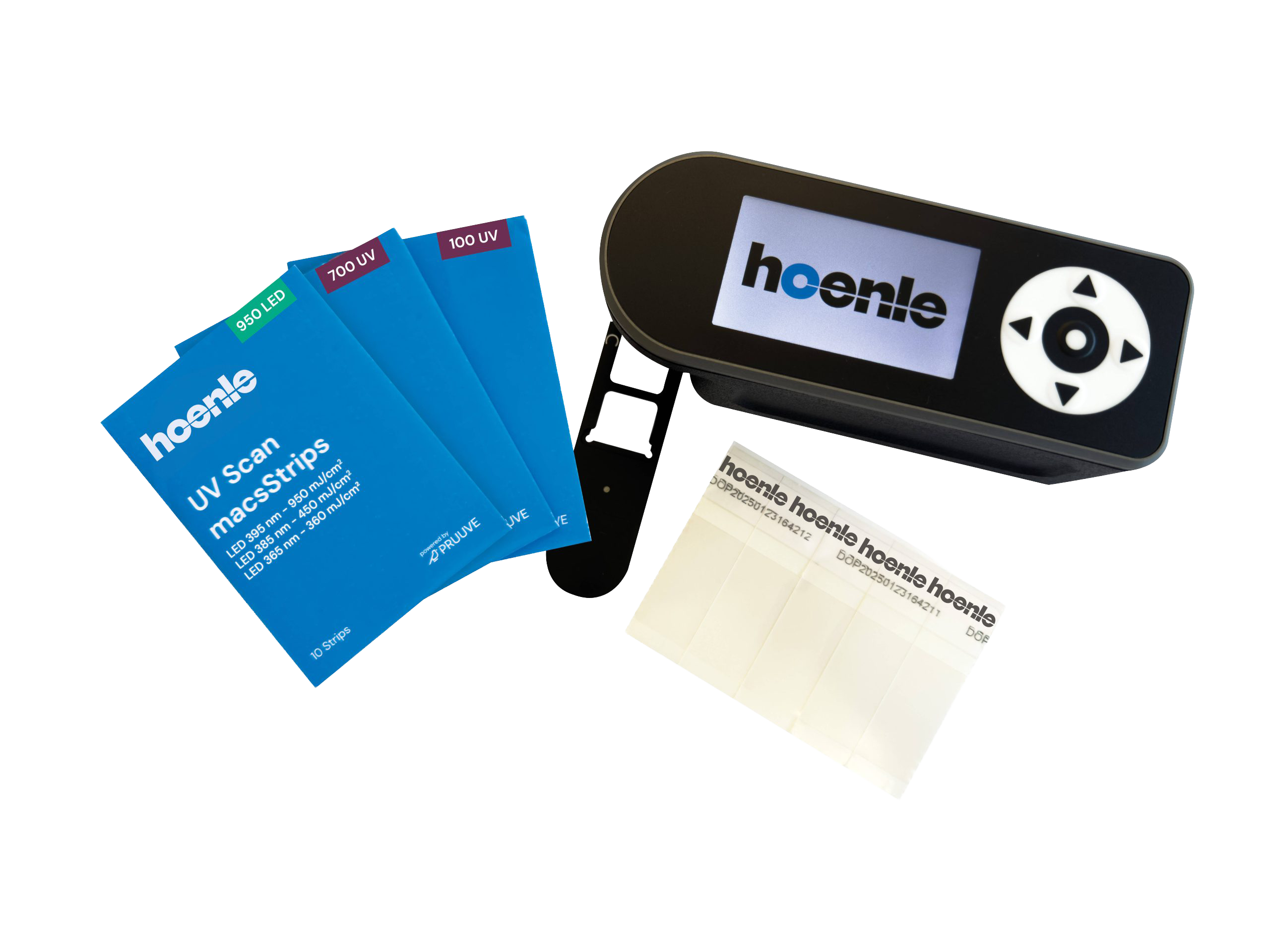
Yes, Hoenle offers a full range of UV process monitoring and dose measurement solutions to ensure consistent, repeatable curing results. Products include the UV Scan MACS for accurate and stable UV dose measurement, along with inline sensors, UV meters, and integrators for continuous quality control in production.
Process monitoring is essential for maintaining consistent cure quality over time, particularly as UV lamps and LED arrays age, helping manufacturers avoid under-cured product and unplanned downtime.
Where can I see Hoenle curing systems in action or get a live demonstration?
Hoenle curing systems can be evaluated in person at the Application Laboratory or at industry trade shows throughout the year. The Application Laboratory allows manufacturers to test their own materials under real UV, LED-UV, or Inert-UV curing conditions before committing to an investment.
Hoenle also exhibits at major industry events — see current Events for upcoming trade show dates and locations, or contact Hoenle directly to arrange a live demonstration.
Do I need a powdersprayer during printing if I use UV curing systems?
A powdersprayer is not needed for the drying process alone. What is essential in an IR/HA application (air circulation between the printed sheets) is not necessary in UV printing.
However, to prevent the printed sheets from sticking together (the “glass plate effect”) in UV printing, a small amount of powder is helpful. The powder particles act as spacers between the sheets.
So, while it’s true that a powder applicator isn’t required for UV printing, it can be very helpful in making the production process run more smoothly.
Does an IR-UV combination make sense for UV-Coatings?
It is not mandatory, but it serves as a highly effective problem solver for specific printing challenges and for leveling in the wood-based materials industry, e.g., in high-gloss applications for kitchen cabinet fronts, etc. Since classic 100% UV coatings contain no water or solvents that need to evaporate, they cure purely through a chemical reaction. Traditional UV lamps naturally emit enough heat, but when using modern UV-LED lamps, adding a separate Infrared (IR) source is an excellent tool in the following cases:
When it makes sense (The Benefits):
- Eliminating “Orange Peel” Effects: UV coatings are naturally thick and viscous. Briefly warming the coating with IR radiation right before the UV-LED lamp lowers its viscosity (makes it thinner). This drastically improves leveling, allows the coating to smooth out perfectly, and eliminates the dreaded orange peel effect.
- Achieving Maximum High-Gloss: Because the IR heat helps the coating flow smoothly into a mirror-like surface before it hits the UV-LED, the final gloss level is significantly higher.
- Faster and Deeper Curing: Chemical reactions accelerate with heat. Pre-heating the coating with IR helps the UV-LED light cure the layers faster and ensures a complete through-cure down to the substrate.
Can I use an IR dryer to dry water-based inks and coatings as well?
Yes, combining Infrared (IR) and Hot Air is highly effective for drying water-based inks and coatings. The two technologies work together to maximize drying speed.
Infrared Light:
- Penetrates directly into the wet layer.
- Heats the water instantly from the inside out.
- Pushes moisture up to the surface.
Hot Air:
- Sweeps away the humid air blanket that forms on top.
- Allows continuous, steady evaporation.
Using both IR and hot air together delivers significantly better and faster drying performance than using either technology alone.
Contact And Support
Do you have any questions or need advice on our curing and drying solutions? We are happy to help you.