Needle Bonding
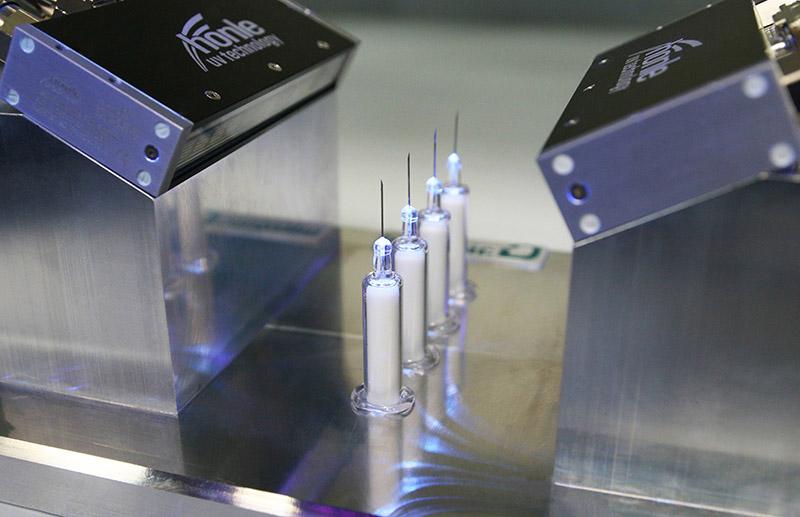
A main field of application for adhesives in medical systems is needle bonding and syringe assembly – the bonding of stainless steel needles or cannulas into glass or plastic syringes. The needles’ required high withdrawal forces are achieved through precision manufacture (needle position, adhesive dosing and reliable adhesive curing), choice of hub (material and design) and, in particular, the right adhesive system.
Downloads
Already the hub material used affects the choice of adhesive, since not all adhesives adhere well to all plastics. Many adhesives are UV-curing, which requires the use of transparent and UV-permeable materials. For materials that block UV light, such as polycarbonates, long-wave LED curing is recommended. All needle bonding adhesives listed in the table below can be LED-cured.
The hub design also plays an important role for the assembly of syringes: it determines whether a mobile adhesive that flows into the needle hub through capillary action or a highly viscous adhesive capable of filling large gaps is used. In some cases the needle shaft must be designed with grooves to provide an additional key for the adhesive.
Hoenle offers various adhesives that are suitable for bonding stainless steel needles into glass syringes and stainless steel cannulas into syringes made from plastics such as PC, PVC, PP or ABS. All adhesives recommended for needle bonding are solvent-free and certified USP Class IV and/or ISO 10993 for use in medical equipment. In addition, high needle extraction forces were measured with all needle bonding adhesives even after several sterilization cycles. Electron-beam sterilization has even been shown to improve the adhesion of some adhesives of the Vitralit® series.
All adhesives are also available in fluorescent versions, which allows a fast and efficient quality control during production.
The table below lists a selection of needle bonding adhesives from Hoenle. Further products and custom solutions for needle assembly are available on request. To download the technical datasheets (TDS) please click on the adhesive name.
| Adhesive | Application Areas | Viscosity [mPas] | Base | Curing * | Special Properties |
|---|---|---|---|---|---|
|
600-900 | acrylate | UV VIS secondary heat cure |
|
|
|
3,000-6,000 | acrylate | UV VIS secondary heat cure |
|
|
|
70 (Rheometer, 25°C) | acrylate | UV VIS |
|
|
|
2,200 (Rheometer, 25°C, 10s^-1) | acrylate | UV VIS |
|
|
|
40-70 (Newtonian liquid, Rheometer, 25 °C) | acrylate | UV VIS |
|
|
|
170 (Rheometer, 25°C) | acrylate | UV VIS |
|
|
|
6,000-10,000 (Rheometer, 25°C, 10s^-1) | epoxy | thermal |
|
*UV = 320 – 390 nm VIS = 405 nm
Contact And Support
Do you have any questions or need support for our bonding solutions? We are happy to help you.