Flip Chip Underfills
In modern electronics manufacturing, the demands on the mechanical stability and reliability of electronic components are constantly increasing. Particularly in highly integrated assemblies such as flip chips or ball grid arrays (BGA), additional stabilization is crucial for a long service life and reliable function. This is where so-called underfills come into play—special adhesives that have been specifically developed to compensate for mechanical stresses and improve the thermal resilience of soldered joints.
To improve thermal properties, modern underfiller adhesives are equipped with nanofillers. These reduce the coefficient of thermal expansion (CTE) and thus increase reliability—a decisive advantage in temperature-sensitive applications.
Epoxy resin-based adhesives are often used because of their impressive capillary flow behavior. They penetrate independently into the narrow spaces between the chip and the circuit board, enabling easy and complete application – even with complex structures.
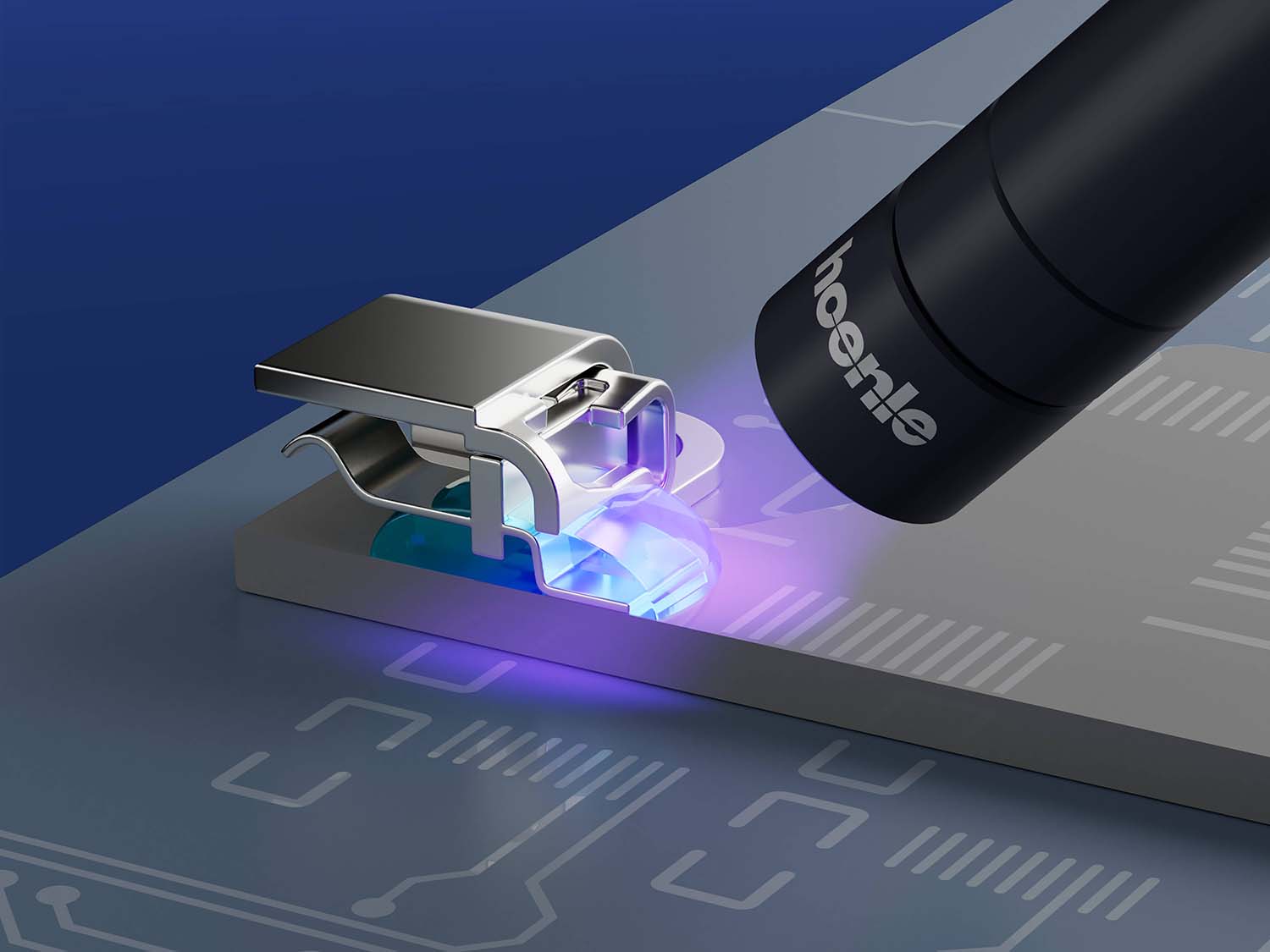
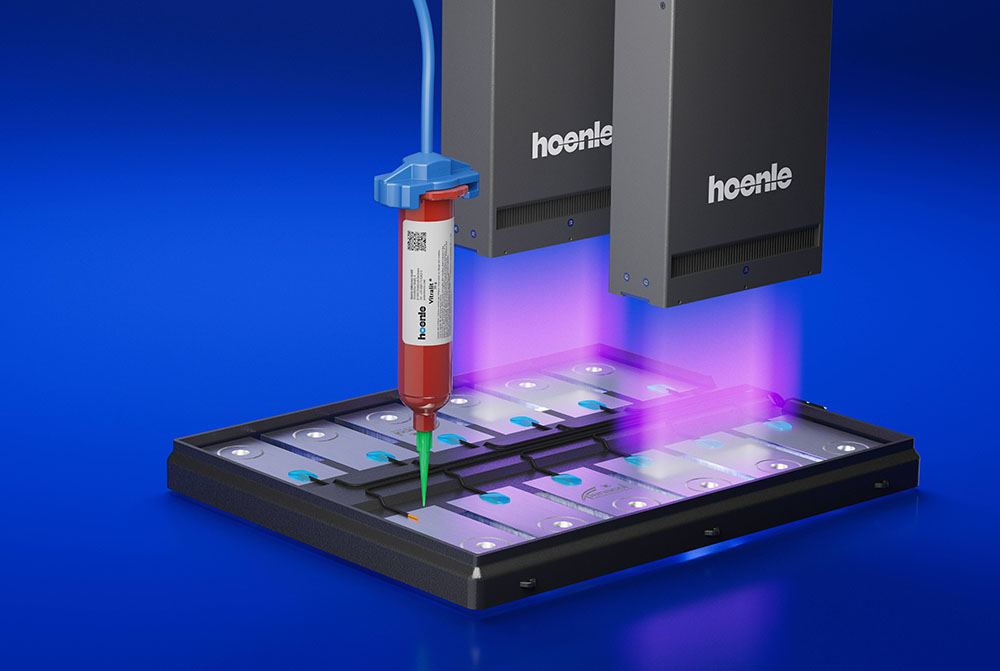
Dual-curing underfill systems are particularly efficient. The adhesive is first fixed in the edge area by UV light before complete heat curing takes place in the shadow zones under the component. This two-stage process ensures reliable and complete curing.
The targeted use of high-quality underfill adhesives can significantly improve the mechanical strength, thermal stability, and long-term reliability of electronic components. This makes them an indispensable part of modern electronics manufacturing—from smartphones to power electronics.
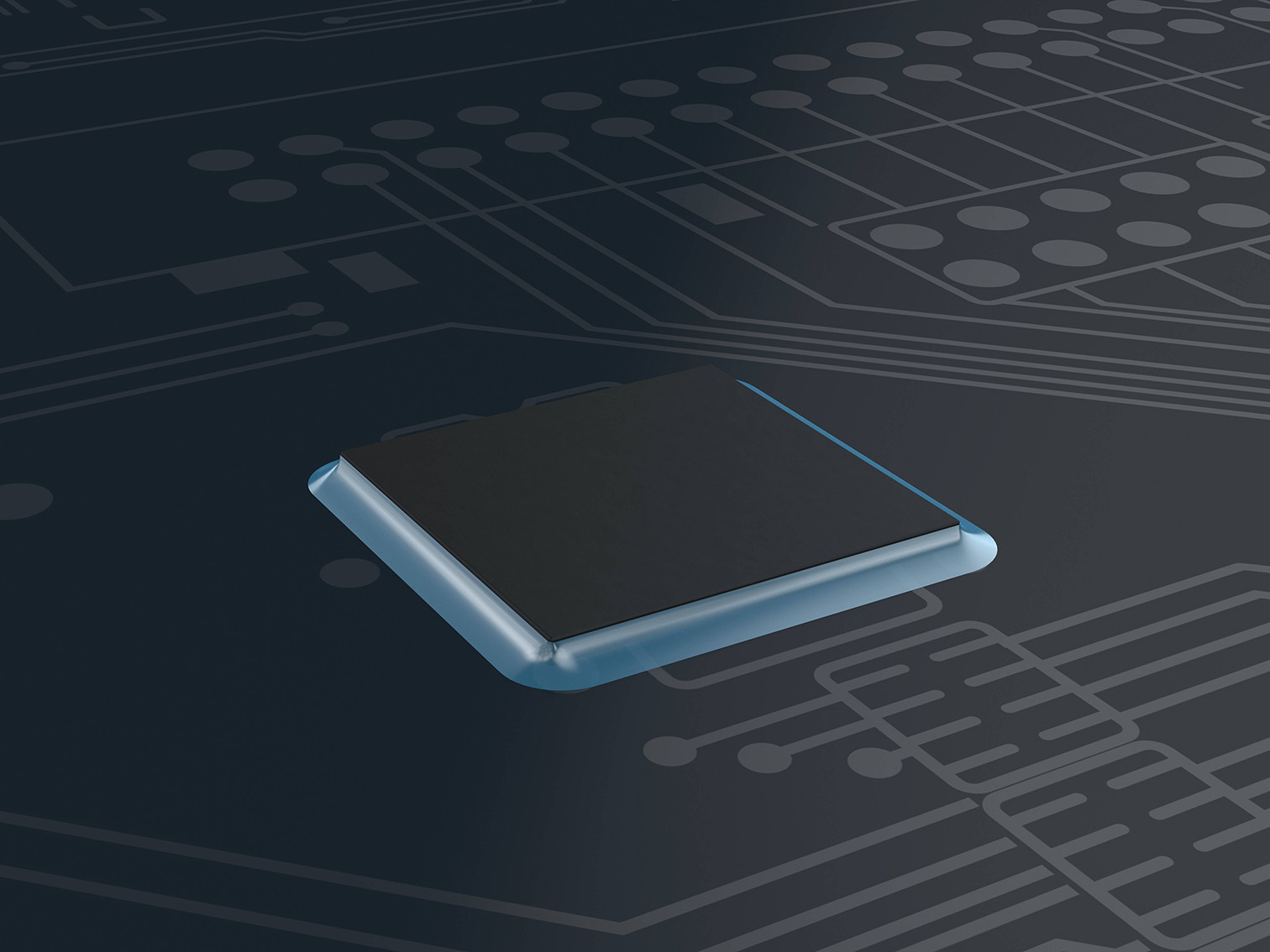
Adhesives serve as underfills for flip chips on printed circuit boards
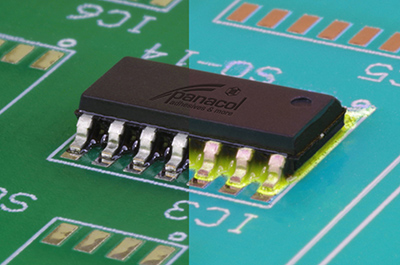
A black, yellow-fluorescent underfill under normal (left) and UV light (right) in comparison
Sustainability thanks to reworkability and recycling
Reworkability makes it possible to process, repair, or recycle products after assembly. This is becoming increasingly important for manufacturers of electronic components, as legislation and environmental organizations continue to push for the minimization of electronic waste. One starting point for sustainable strategies is the reworkability and repairability of individual modules on printed circuit boards in order to counteract the scrapping of entire components or modules.
Some underfill adhesives from Hoenle are specially designed for this “reworkability”: they can be removed again when exposed to temperatures above the glass transition range of 150°C. Up to this temperature and application range, the epoxy resins adhere reliably. Only above this critical temperature threshold does the product become reworkable. To make the adhesives easily recognizable, the black adhesives fluoresce yellow when exposed to short-wave light.
The table below provides an overview of Hoenle adhesives that are used as underfill. To download the technical datasheets (TDS) please click on the adhesive name.
| Adhesive | Application Areas | Viscosity [mPas] | Base | Curing * | Special Properties |
|---|---|---|---|---|---|
| - | 150-300 | epoxy | UV secondary heat cure |
|
|
| - | 200-500 (Rheometer, 25°C, 10s^-1) | epoxy | thermal |
|
|
| - | 300-400 (Rheometer, 25°C, 10s^-1) | epoxy | thermal |
|
*UV = 320 – 390 nm VIS = 405 nm
Contact And Support
Do you have any questions or need support for our bonding solutions? We are happy to help you.