Adhesives as Liquid Gasket or CIPG
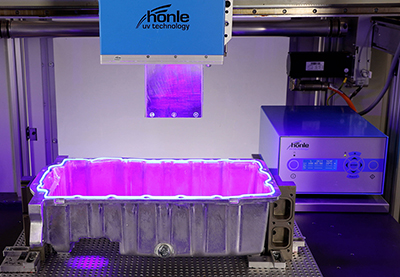
Adhesives are often used in industry as liquid gaskets, so-called formed-in-place gaskets (FIPG) or cured-in-place gaskets (CIPG). Liquid-applied gaskets are particularly suitable for sealing difficult 3D geometries that cannot be reliably sealed with conventional gaskets, stamped parts or sealing tapes. Compared to silicone sealants, adhesives as liquid seals cure much faster. With adhesives, individual parts can be bonded and sealed at the same time.
UV curable CIPG system solution from Hoenle and Atlas Copco
CIPG solution from Hoenle and bdtronic
Liquid gaskets also have a low compression set, i.e. after being subject to pressure, they fully or partially return to their original shape and dimensions.
Cured-in-place gaskets protect sensitive electronic components against dust, moisture, aggressive media or temperature. They are used in lighting technology, the electrical and electronics industry or in the field of electromobility. Typical areas of application for CIPGs are electronic control units (ECU), cameras, sensors, on-board chargers (OBC) and switching units (e.g. BDU – Battery Disconnect Units).
The CIPG material is usually applied directly to the housing and then cured. In contrast to a liquid gasket (FIPG), in the CIPG process the matching housing cover is only fitted after curing. Surface pressure on the CIPG bead creates a sealing effect, which is usually reinforced by an additional force or form fit. As the sealing bead has a higher adhesion to the housing base than to the cover, even more frequent disassembly processes are possible without permanently damaging the material. CIPGs are therefore detachable seals that can be used several times.
In the following table you will find a selection of elastic adhesives that are suitable as liquid sealants or CIPG for sealing enclosures. Technical data sheets can be downloaded by clicking on the adhesive name.
| CIPG/UV Gasket | Viscosity [mPas] | Base | Curing * | Special Properties |
|---|---|---|---|---|
| 5,000-10,000 (Rheometer, 25°C, 10s^-1) | acrylate | UV VIS |
|
|
|
Vitralit® CIPG 60101
|
30,000-60,000 (Rheometer, 25°C, 5s^-1) | acrylate | UV VIS |
|
| 15,000-40,000 (Rheometer, 25°C, 10s^-1) | acrylate | UV VIS |
|
|
| 150,000 cps | acrylate | UV/VIS |
|
*UV = 320 – 390 nm VIS = 405 nm
Contact And Support
Do you have any questions or need support for our bonding solutions? We are happy to help you.